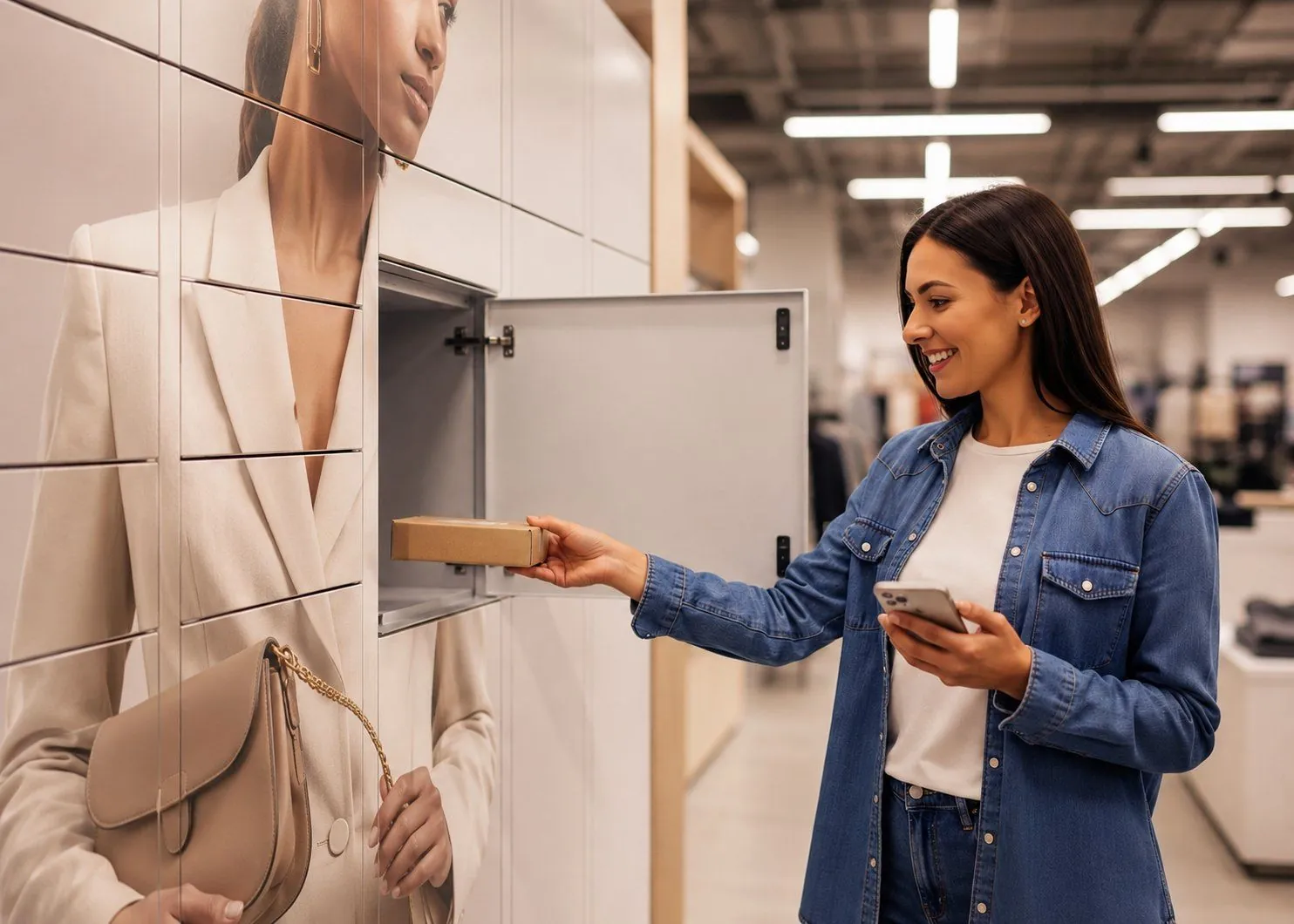
Every retailer reaches a point where in-store collections and returns stop being a service promise and start becoming a control problem. A few more customers choose to collect in store. A few more returns come back through the desk. Parcels get held wherever there is space. Colleagues build workarounds, because that is what good retail teams do to keep the journey moving.
Then the numbers get reviewed. Finance asks what collections cost this quarter. Operations asks why store teams spend so long on handovers. Customer teams ask why a convenience journey still creates queues and complaints. That is usually when the real risk becomes visible.
The risk is not only that an order might go missing or a return might be disputed. The larger risk is that a strategically important journey is still being run through manual effort, partial records and local workarounds.
The direct answer
Retailers reduce risk in collections and returns by creating a controlled, automated and traceable handover. Instead of relying on a colleague to find an order, check details, complete the handover and later recall what happened, the retailer builds a clearer chain of custody. Customers collect orders or deposit returns through a guided self-service workflow. Access is controlled, events are time-stamped, activity is visible and exceptions are easier to spot.
That reduces five connected risks:
- Dispute risk, because the retailer has a clearer record of the collection or return event.
- Fraud and loss risk, because activity is more attributable.
- Operational risk, because routine handovers no longer depend so heavily on colleague availability.
- Financial risk, because collection and return activity becomes easier to measure.
- Customer experience risk, because the journey becomes faster, clearer and more consistent.
This is the important distinction. It is not simply about installing a click and collect locker system. The stronger opportunity is an automated collections and returns workflow that lowers manual handover cost, improves accountability and gives the customer a smoother journey.
The real risk is ambiguity
When retail leaders think about risk here, they think first about missing orders, returns fraud, disputed handovers and complaints. Those risks are real. But underneath them sits a deeper problem: ambiguity. If a customer says they collected an order and the store record is unclear, the retailer has ambiguity. If a return is dropped off but not traceably recorded, the retailer has ambiguity. If colleagues spend time searching for parcels and that effort is never measured, the retailer has ambiguity.
Ambiguity is expensive because it forces the business to reconstruct events after the fact. It pulls colleagues into investigations, slows customer service, weakens fraud prevention and makes cost-to-serve hard to evidence. Automation reduces that ambiguity by making collections and returns traceable by design. Instead of asking "what do we think happened?", the business can ask "what does the record show?"
Why risk shows up during cost reviews
Collections and returns risk often becomes most visible when finance, operations and customer teams review performance against plan. At the start of the year a manual process can look manageable, and the labour model looks workable. A few months later the picture changes. Store labour is under pressure, service desks become bottlenecks, and customers are still waiting and complaining.
Manual handovers make it hard to answer the questions that matter most. How many colleague minutes are absorbed? Which stores are under the most pressure? How many exceptions are created? How often are customers waiting? Retail collections automation gives the business a more evidence-led way to answer those questions. It matters because retail labour is under increasing scrutiny, and rising employment costs mean retailers need to understand where colleague time is going and whether repetitive manual work can be reduced.
Why manual handovers create risk
Manual retail processes often survive because store colleagues make them survive. They retrieve parcels, update systems, manage queues, check details, accept returns and keep the customer calm. In many cases it works because colleagues are experienced and adaptable. That does not make the process bullet-proof. A strong process should not depend on colleagues constantly compensating for weak visibility, and the retailer should not only learn the true cost of the journey when finance starts asking difficult questions.
Automation reduces this risk by moving routine handovers into a more controlled workflow. Store teams keep oversight, but they are no longer required to personally manage every standard collection or return. The goal is not to take people out of retail. It is to stop using skilled colleagues as the control mechanism for a process that should be simpler, faster and easier to evidence.
Reducing dispute, fraud and returns risk
Order disputes are one of the clearest risks in click and collect. A customer says an order was not available. The store believes it was collected. A parcel cannot be found quickly. A service team has to investigate. In a manual process the evidence is fragmented: one system shows one thing, a colleague remembers another, the item has moved between locations.
Automation reduces this risk by creating a clearer chain of events. A collection becomes a controlled access event rather than a handover at a busy desk. The customer gets the relevant instruction, the item sits in a secure compartment, the collection completes through a defined process and the activity is recorded. That gives teams better evidence if a query arises, and it reduces the chance of disputes emerging from confusion in the first place.
Reducing hidden labour and cost-to-serve risk
One of the most common weaknesses in manual click and collect is that the cost hides inside normal store labour. A colleague spends three minutes finding an order. Another spends five minutes resolving a query. A return takes longer than expected. A queue forms. None of those moments looks significant on its own. Across an estate, they become a cost structure.
The issue is not whether colleagues are capable of managing the journey. They are. The issue is whether the retailer wants growth in collections and returns to keep creating a near-linear increase in colleague intervention. That model is hard to scale and makes the true cost of click and collect hard to defend. The commercial conversation should not be "lockers versus people". It should be "manual dependency versus controlled self-service". A well-designed self-service journey supports stores rather than undermining them, removing the repetitive work that creates pressure while keeping colleagues involved where they genuinely add value.
Reducing cost-per-order risk for finance
Finance teams do not usually challenge collections and returns because they dislike the services. They challenge them because the economics are often unclear. How much does each collection cost? How much colleague time is involved? Which stores are under the most pressure? What happens at peak? If the retailer cannot answer those questions, cost-to-serve stays partly hidden.
Automation helps by making activity easier to see, measure and compare. Usage patterns become clearer, activity can be reviewed by location, exception rates can be identified, and a pilot can be measured against operational and financial assumptions. In a manual process every order carries a hidden labour cost: receiving, staging, searching, retrieving, checking, handing over and managing exceptions. Across thousands of collections that becomes a repeatable cost line buried in store labour. This is where automated collections and returns become a business case issue rather than a hardware conversation.
Improving customer experience and store operations
Click and collect is meant to be convenient. That promise weakens when the customer has to queue, wait for a colleague, explain their order and watch someone search for it, or get a different process depending on the store. Customers do not see those moments as operational issues. They see them as the brand experience. Physical stores remain important to omnichannel retail, including their role in supporting online channels through collections and returns.
Automation reduces negative experience risk by making the journey more predictable. Customers get clear instructions and can collect or return without waiting for a colleague to become free. The key is design: a poor self-service journey simply transfers effort from the retailer to the customer, while a strong one removes effort for both. The same logic applies to operations. A collection and returns system has to fit different store formats, work at peak, and reduce pressure rather than move it somewhere else.
Proving value safely
Retail decisions of this kind are rarely made by one person. The champion may make the problem visible, but finance, operations, customer experience, IT and procurement all need confidence before a pilot or rollout can progress. So risk reduction is not only about the workflow. It is about how the project gets proven. A pilot should test more than technical function. It should test operational fit, colleague impact, customer adoption, exception handling and whether the process stays stable when the store is under pressure.
This matters for IT too, which is often the hidden gatekeeper, responsible for making sure a new solution does not introduce unacceptable security, support or integration risk. The strongest route is usually phased: begin with a pilot that proves the operational and commercial case without forcing unnecessary integration complexity on day one, then learn where deeper system integration would add value.
Where to start
Risk in collections and returns is not only about what might be lost, stolen or disputed. It is about what the business cannot see, cannot prove and cannot scale with confidence. Automation brings that under control by replacing people-dependent handovers with traceable workflows, giving clearer records, controlled access and better evidence when the numbers are reviewed. If your team is reviewing collection costs, returns risk or store workload, the question worth asking is simple: where are we still relying on manual effort, incomplete records and store-level workarounds to protect a strategic journey? eLocker handles both directions on one platform, so the answer is the same audit trail for collections on the way out and returns on the way back.
